

City Kayakers in the Last Frontier
Updated: Feb 22

It may not have been a soccer ball, but Wilson was without equal on Squirrel Island. Craig, a CEO of a large company in Orange County, CA, graded the 6-foot strip of rocky beach and shored it up with a weathered and waterlogged 2 x 6 that had washed ashore. We felt reasonably confident that it wouldn’t disturb the ecological balance since the tide would rise 18 feet we’d earlier determined, seasoned Alaskan kayakers that we were after 9 days at sea.
Squirrel Island was our last night of a 150-mile expedition kayaking trip in Prince William Sound in Alaska. Each day we averaged about 15 miles kayaking, and every night we set up camp on a different island. Tonight, we were on one of the smaller islands, which at its highest point, a granite boulder, was only 40 ft. above sea level, and our tide guide said the tide would be coming in 18 ft. tonight. There had been other nights where it came in 26 ft. or more, but Squirrel Island was so small that there barely seemed like enough high ground to pitch our tents this time, and I hoped we wouldn’t get swept away in the tide while we slept. A sad end to such a grand adventure.
We were all exhausted tonight after our four-mile channel crossing across the shipping lanes while trying to outrun an incoming storm. Between our five kayaks, three tandem and two singles, I had drawn the single for today, of all days. The guide was in the other single, and the six men in my group paired in the tandems. The entire adventure, from day one, had been a time of self-discovery in ways I thought unimaginable, but this crossing had tested all of my limits. I was a fairly athletic woman, having come off of 3 years of daily trail-running, bicycling and hiking. While I wouldn’t call myself a strong swimmer, I definitely knew how, and I had fortified my education for this trip in swimming pool classes and then in the ocean in Santa Barbara learning how to right-side my ocean kayak in case it capsized. One could die of hypothermia after 8 seconds in the frigid waters of the arctic, I was told.
Muscles in my arms and shoulders, on fire from the hours of continuous strain, cramps in the muscles of my rear and legs from being immobilized for the same, I had crawled my way across the channel, up and over the repetition of five to six foot waves, strong winds whipping my hair around me, my Columbia waterproof hat straining at the knot at my neck. This wasn’t like the 100-mile bicycling tour I had taken once through Scotland, where I could rest if tired, or if unable to ride, set up camp or pay for a bed and breakfast if nearby. There was no resting, no fall back plan. If I rested, I would be handing over my control to the storm and waves. Certain death. So I hung on for dear life, facing each wave head-on, so as not to capsize, at times teetering in terror as I clung to the crest of a wave, until I raced down the other side and then did it all over again hour after hour. The others were facing the same, but I was only peripherally aware of them in my intense concentration. As we hit midway, the waves changed direction and the front side at your back was worse than facing them, because there was always fear that the waves would crash on top of you and send you to the bottom of the ocean. I had kayaked often off of the Gaviota coast and a few times each near Catalina and Anacapa Islands, off the California coast, but the warmer waters and fact that I could see the shore somehow made it less scary. I don’t think I have ever felt so helpless and terrified in my life. In hindsight, that is. I didn’t have time to consider fears or feelings at the time, so focused I was on mere survival and fueled by adrenalin.
Finally reaching the island on the other side, we still couldn’t pull in to rest lest we get stranded on the treeless, rocky shore and open to the elements and the storm. We picked up our pace and wound our way around until we found a small bay, more protected from the harsh winds. There, we staggered out of our kayaks, dragging them way up above the shoreline and securing them, because safety was still paramount when you were alone in the wilderness, no matter how tired or physically and emotionally battered you were. This is how we arrived at Squirrel Island.
After pitching our tents and the cook tent and securing them with extra chords and stakes to withstand the storm, we raided our last supplies of wine. If ever there was a day for it, this was it. All of us, including the guide, were spent of every last shred of sanity I think. After almost two weeks of traveling together and facing the day we just had, we had decided that a bond of brotherhood had been forged between us. I was too exhausted to quibble over gender. I raised my Sierra cup.
Brad, whom we’d named Bear earlier in the trip for his height and breadth and amazing ability to instantly fall asleep, sprawled out in the middle of foot high grass and brush during our hour-long afternoon breaks, had unearthed a Styrofoam buoy that must have marked the shipping lanes in the channel we had crossed that day. It was weathered to a dingy algae-stained yellow (I knew better than to call it cerise in this group!) It had sizable chunks gouged from its face, but it made for a perfect "Wilson," borrowing from the supporting volleyball character of the Tom Hanks movie, "Castaway".
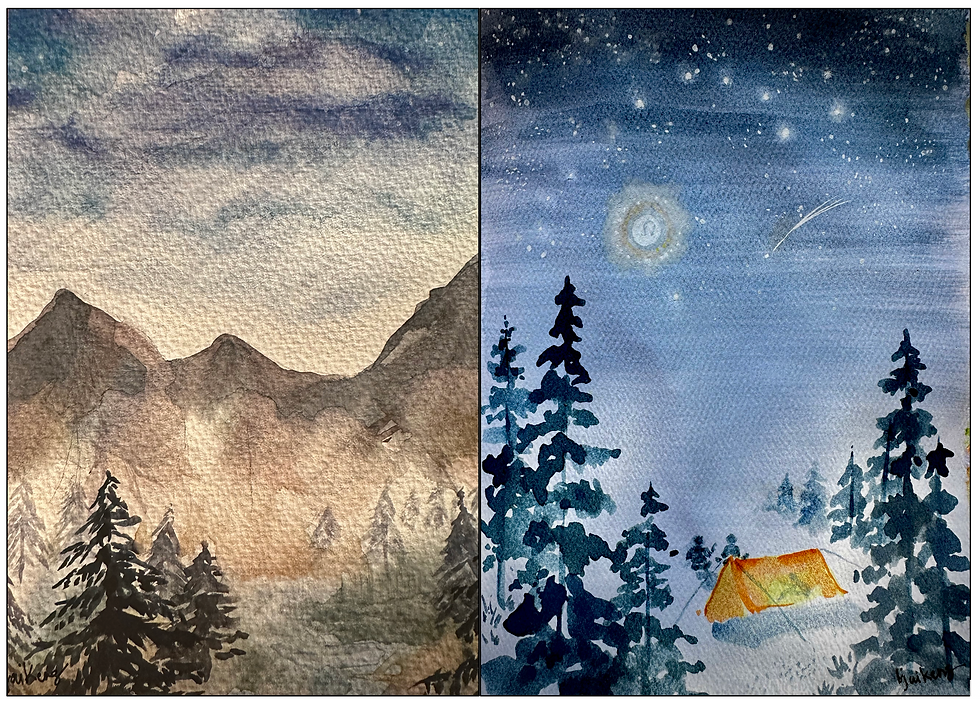
The guys, now on their fourth or fifth Sierra cup of Trader Joe’s Delicata boxed wine, had deemed it a fine idea to decorate Wilson with found treasures such as eagle feathers, mandibles of long since passed marine life and other bits of flotsam and jetsam washed up on the shore. Sierra cups raised, they cheered on the artist of the group, as I had been dubbed, to bring Wilson to life. Once fashioned, they thought of a plan to string him up on the pine branch overhanging the beach. Patrick, the scientist from Vandenburg Air Force Base, inspected Wilson for evidence of any biohazards then recalculated the tides, the barometric pressure and wind velocity to determine the ideal location for the hang. I could have saved him the trouble since there was only one branch that overhung our camp, but one thing I had learned on this trip was that men had a whole fascinating ritual of crowing and beating their chests among themselves. The artist grabbed her congratulatory cup of wine and sat on the log to watch six inebriated men pay homage and give confessions to Wilson.
This trip had been one wild adventure, and an eye-opening one about the nature of the male human species. Being the oldest of four sisters, with seven aunts, I really had no idea of the nature of man when they aren’t trying to impress a woman. While I had been invited by my friend, Patrick, when another of his friends had cancelled last minute, so blinded by the thought of a grand adventure, I didn’t really give thought to gender dynamics beyond the thought that I would be safe with six men, wouldn’t I? The logic of that baffles the mind now, given my own early history. Turns out I was safe, but only because they seemed to revert to age 14 when traveling together. The only exception being to when I had been paired with Bear in a tandem kayak on the day we explored Chenega Bay.
It was our third day out that we were in for a real treat. The reason we had all taken this expedition, really. To see glaciers and icebergs up close. The days before we had tooled around to a couple of lush islands in our kayaks, learning to steer and paddle with confidence, while we saw stunning waterfalls, thundering riotously into the ocean, black bears fishing near the shore, moose with their impressive antlers spanning six feet curiously watching us from the Spruce woodlands. Only this morning, we had wound our way along the coast and paused to watch the black-legged kittiwakes nesting by the thousands in the cliffs above. Only by water travel is one lucky enough to see this. Our guide, busily handing out sandwiches and fruits at lunch, kept to himself the knowledge of what our afternoon would bring, merely hinting at a surprise.
The collective catch of breath upon our first glimpse of Chenega Bay, with its backdrop of the Chenega Tidewater Glacier brought a huge grin to the guide’s face as he watched us. He later said he never tired of witnessing that moment. Like trying to fully capture the beauty and magnitude of a sunset by camera always falls short, so had all of the photos we had ever seen of glaciers in Alaska. For long moments, we just sat in our kayaks, motionless, and stared in awe, periodic sighs of wonder expelled from each of us. After a time, the guide corralled us into a kayak huddle, while he went over the dangers of kayaking through an ice floe near a glacier.
Carefully maneuvering through the ice floe, trying for minimal scrapes on our bows so as not to damage the fiberglass, we were reminded of how exposed we were to nature, where one careless move could prove fatal. As city folk, most of us had in our offices, or had seen at least, those motivational posters where the tip of an iceberg is labelled success, and the 80 percent of the iceberg below delineated the unseen foundation supporting the tip, hard work, persistence, determination, discipline, etc., so we knew that most of any iceberg lay below the surface. Head knowledge in the wilderness is not the same as first-hand experience, case in point. Through the pthalo blue water, we could see these dwarfing proportions. If you paddled too close or too quickly and upset the delicate balance of water on ice, an iceberg could flip in an instant, taking you with it.
Bear, my tandem kayak-mate today, thought it might be fun to scare me by rocking the kayak back and forth, instilling fear of the exact danger of which we’d been just warned. My outraged squawk was absorbed by the thunderous sound enveloping us. I gripped my paddle to the sides of the kayak and hung on for dear life as I ventured a look behind me to see his laughter but heard none of it. To both sides of us frantic arm signals to desist, from the guide and others, finally registered through the mud in his brain. He took a tongue lashing from every man on the trip that night. I wouldn’t ride with him again. You must be able to trust your kayak-mate. Your life may depend upon it.
The backdrop and star of this bay was, of course, the Chenega Glacier itself, a huge monolith of ice in varying hues of blue. Ice looks blue because the ice absorbs the longer red wavelengths of white light and the shorter blue wavelengths travel and scatter through the ice making the color blue visible. The longer the blue wavelengths travel, the darker the color blue appears. Accompanying this visual wonder is a thunderous cracking and calving of the ice from the ice cliffs, which break off and crash into the sea in a great uproar. I realized that the photos and movies I had seen in which kayakers appeared to glide peacefully along, hugging the coast of tidewater glaciers, were merely camera angle tricks. We stayed at least a half-mile or more back and a good distance from the closer icebergs for several reasons. The ice chunks that calved into the water at the base of the glacier were as large as buildings, and as such, they caused large waves fanning outward, upsetting the ice floe and flipping some icebergs. No one with any sense wanted to be caught unawares in the middle of such tumult. After that, there was the dangerous popping back up of the large chunk itself some ways away from where it landed. The whole experience left us acutely aware of our smallness in nature. If we didn’t already have it, our respect for the magnitude of natural forces grew tenfold.
Early in the evening, in synchronized quiet paddling we made our way past The Pleiades, a seven-island cluster, until we reached Knight Island, each lost in thought, humbled by all we had experienced that day. Bear took his tongue lashing, but after dinner, the reflective mood returned, and we all sat on a huge boulder in silence and listened to the mournful keening of the pod of pilot whales as we watched them travel past us through the starlit sea. The light was finally fading at about 11 pm, but none seemed want to move, each still ensnared in their own reveries.
I thought about The Pleiades Islands, which had been after named after a seven-star-cluster in the Alaskan winter sky.

While many of us attribute the star stories to Greek Mythology, this star cluster actually had incredibly similar stories originating from primitive cultures of Africa, Australia and Greece. In each of these stories, seven sisters or maidens or girls were being chased by Orion, a nearby star cluster. According to Greek Mythology, I remembered that Zeus, to protect the seven daughters of Atlas from harm by Orion, had thrown them into the sky as stars. Thinking about the unanswered questions about how such stories could be so much alike when cultures didn’t intersect prior made me think of the mystery of the Creation Story as told similarly by a multitude of ancient cultures and religions. These mysteries, while confounding to some, to me only supported the idea that God was far greater than we could ever imagine. Knowing that made me feel safe.
As we focused on nothing and everything at once, a slight glow stole over the horizon, a swirl, a trick of the eye we thought at first. This was late summer after all. Holding our breaths, hoping we were right, we waited another hour as the sky darkened a fraction more. The stars began to make themselves known, one by one. Stargazers like me know that the more you look, the more you see when it comes to the night sky. On this island in the ocean off of the Alaskan mainland, there was no light pollution to obscure the beauty. There it was! Great glowing and slowly waving greens and blues and touches of reds of our first Aurora Borealis.

We looked at each other, wide eyes of wonder, reflecting green and blue and red, before swinging them back to the sky. The Milky Way made a wide swath bejeweling the green like glowing diamonds and diamond dust. I took it all in with suspended breath and swelled heart. The pilot whales breaching slightly for air again, caught my eye, as they glided through the ocean of reflected green, blue, red and diamond dust. We all stayed up far longer than we normally could have, for fear we would lose even a second of nature’s Laserium light show and symphony. Eventually, one by one, each of us silently slipped off into the night to our tents, hearts and minds full with the gift we had been given.
These are just a few glimpses into a 10-day adventure that changed my life. Every so often in life, if we are lucky, we get to experience an adventure of this magnitude. An adventure that prompts reflective connections throughout life and reminds us of what we are made of. This one came after a seven-year marriage where I was left doubting my own worth, strength, and courage as a woman. When the opportunity unexpectedly arose, I jumped at it. Was I ready for it? No. Was it the safe thing to do? Maybe not. Was it impulsive? Certainly. No question! I have been blessed enough to have had several grand adventures in life, each one of them a once-in-a-lifetime experience. I stretched myself beyond what I felt at the time I was capable of doing, and grew for the experience and gained confidence for the next adventure to come.
Fifteen years later now I think about that pristine area, the effects of climate change, the mass dying of Alaskan sea birds, the deforestation of millions of acres of spruce, native to Alaska and subsequent loss of habitats for many Alaskan animals, the drilling and fracking of an area that provides some of the most important resources of this earth that balance and sustain life on our planet, and I mourn our shortsightedness and greed. I think of the peoples that lived thousands of years ago and hundreds of years ago. How the harsh physical conditions only brought them closer as people, with a respect for each other and a respect for their environment, plants and animals. I acknowledge that some of these are also what made it possible for me to get to experience this adventure, a paradox that I don’t take lightly, for in essence, I contributed to that which I mourn.
____________________
Please leave a comment! I would love it if you would scroll to the bottom to leave a little comment at the end of each blog post read to let me know how you engaged with the topic and/or artwork. (below the "Recent Posts" section) and/or click the heart button if you liked the post. Thank you!!!
Note: All artwork, stories and observations posted within should be credited to the author, Linnie Aikens Lindsay (unless cited in the post). Permission is required for any use of my words or artwork. Taken from my work, "My Life As Wallpaper Art".


Comments